Introduction
A low doc construction loan in 2026 remains the primary pathway for self-employed Australians to fund a new build when conventional full-documentation finance is not available. Income variability, complex business structures and tax-minimisation strategies often mean tradies, contractors and small-business owners cannot produce two consecutive years of ATO notice of assessments in the way a major bank demands. For those borrowers, a low doc construction facility replaces personal tax returns with alternative income evidence—business activity statements, accountant’s letters, bank account turnover statements—and disconnects the maximum loan amount from a single, static valuation by releasing funds progressively against the builder’s invoices.
The 2026 market sits between a moderating Reserve Bank cash rate (the RBA last adjusted the target in 2025; futures imply a neutral setting of 3.35–3.60% across calendar 2026) and unchanged macroprudential guardrails. APRA’s minimum serviceability buffer, first raised to 3.0% in 2021, remains unchanged as of 5 January 2026, meaning all low doc applicants—full doc too—are assessed at the higher of the product rate plus 3.0% or the bank’s floor rate. For the self-employed borrower funding a construction project, understanding exactly what documents satisfy each lender, how LVR caps differ between owner‑occupier and investor builds, and what the progressive drawdown schedule costs in interest and fees is essential before a slab is poured.
This article summarises the state of low doc construction lending in Australia in 2026, cites relevant regulatory benchmarks and explains the step-by-step mechanics of a build loan from initial approval to final occupancy. It is not personal financial advice; borrowers should consult a licensed mortgage broker.
What a Low Doc Construction Loan Is—and Who Uses It
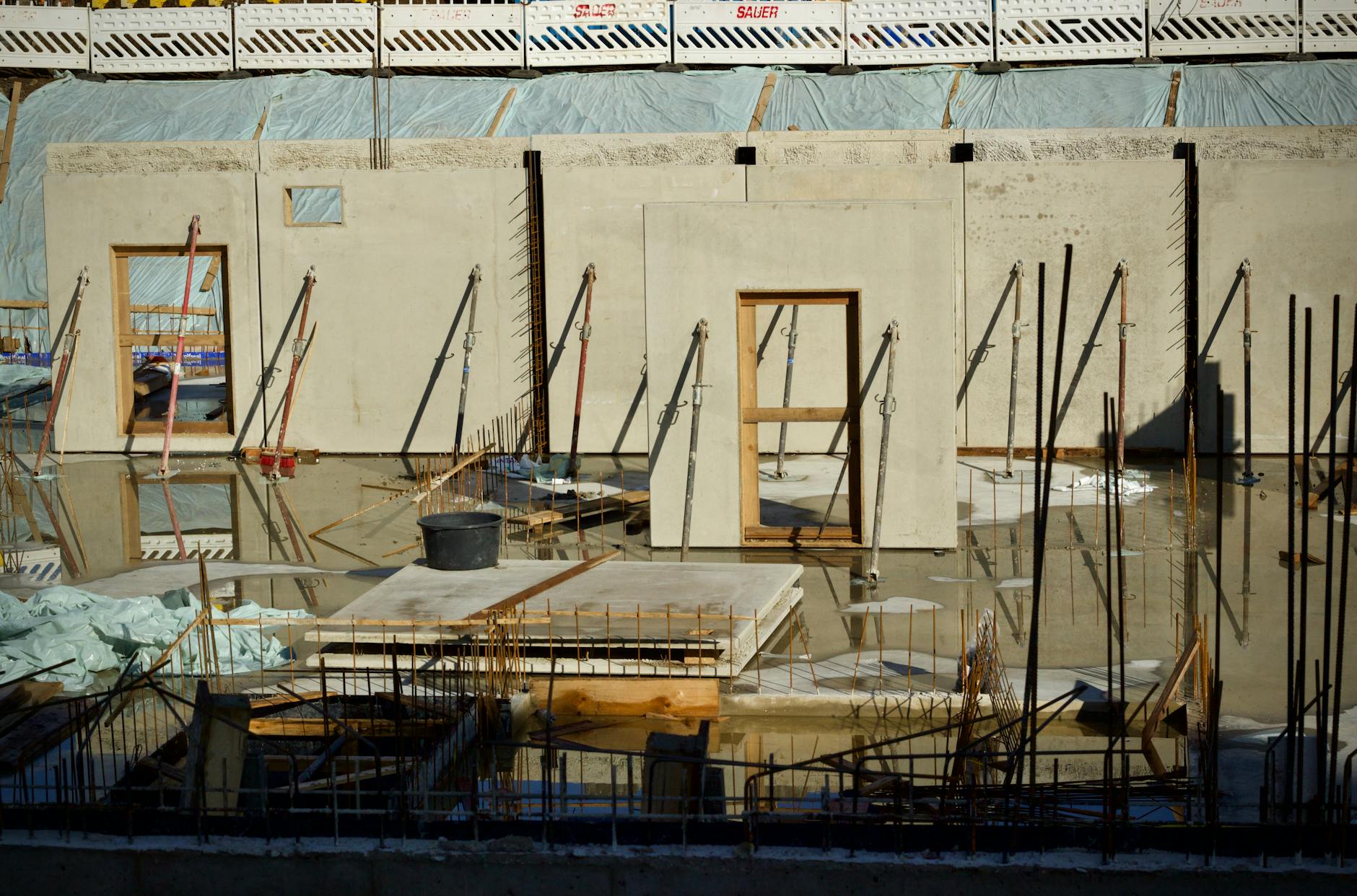
A low doc construction loan is a variable‑rate (occasionally split‑rate) facility that funds a residential building project in instalments linked to six standard construction stages—deposit, slab down, frame up, lock‑up, fixing, and completion. The “low doc” label means the borrower can satisfy the lender’s responsible‑lending obligations without lodging the full suite of financial information required for a prime full‑doc application, specifically without two years of ATO Notice of Assessment and corresponding tax returns.
Instead, income is verified through one or more of the following documents, which the Australian Securities and Investments Commission accepts as reasonable steps under Regulatory Guide 209:
- Twelve months of Business Activity Statements (BAS) lodged with the ATO, showing gross turnover and GST paid. Lenders typically annualise the last four quarters and use a percentage of gross revenue—often 50–65%, depending on the industry.
- An accountant’s letter confirming the borrower’s income history, business stability and capacity to service the loan. Most prime lenders insist the accountant is a registered tax agent or CPA.
- Six to twelve months of business bank account statements, from which the credit assessor calculates average monthly credits and applies an industry‑specific margin.
- A self‑declared income statement, though this alone now rarely meets the standard of a major bank without supporting BAS or account statements.
The typical borrower is a sole trader, partnership or director of a private company with an ABN registered for at least 12–24 months. In 2026, several non‑bank lenders have reduced the minimum ABN requirement to six months for specialist construction products, but those loans attract an additional risk fee of 0.50–1.20% upfront.
The 2026 Lending Landscape: Rates, Regulation and the RBA

Rate‑sensitive readers need precise numbers. As of March 2026, the cash rate target set by the Reserve Bank of Australia sits at 3.60% (source: RBA cash rate page—https://www.rba.gov.au/statistics/cash-rate.html). Major banks’ standard variable owner‑occupier construction rates range from 6.29% to 6.89% p.a. (comparison rate 6.55–7.14% p.a.), and low doc add‑on margins run 0.25% for near‑prime borrowers to 2.00% for specialist non‑conforming products, placing the annual percentage rate between roughly 6.54% and 8.89% p.a. depending on the loan‑to‑value ratio (LVR), credit score and documentation tier.
APRA’s prevailing macroprudential settings are critical in 2026. The serviceability buffer—APRA requires lenders to assess new loans at the product interest rate plus 3.0% or the bank’s specified floor (currently no lower than 5.25%), whichever is higher—remains in force (APRA prudential practice guide APG 223, available at https://www.apra.gov.au/residential-mortgage-lending). For a low doc construction loan priced at 7.50% p.a., the serviceability assessment rate becomes 10.50%, dramatically reducing maximum borrowing capacity compared with full‑doc applicants who may receive bigger rate discounts. The debt‑to‑income (DTI) ratio also stays on lenders’ dashboards; APRA has not prescribed a hard cap, but most prime lenders set internal DTI limits of 6.0–7.0 times total gross income, and the low doc segment often sees stricter internal DTI caps of 5.0–5.5.
A further layer for foreign‑ownership scenarios comes from the Foreign Investment Review Board. Under the Foreign Acquisitions and Takeovers Act 1975, temporary residents and foreign persons generally cannot buy established dwellings and must apply for FIRB approval for new dwellings, land for residential development, or the construction of multiple dwellings. In 2026, FIRB application fees for residential land start at $14,100 for properties valued under $1 million (source: Treasury FIRB fee schedule—https://firb.gov.au/). A low doc construction loan for a non‑resident borrower or a temporary visa holder will require FIRB approval before settlement of the land component and cannot be drawn until both the land settlement and any building‑only FIRB conditions are satisfied. Most lenders cap LVR at 60% for non‑resident construction, and some require a 20–30% cash buffer covering cost overruns.
How Lenders Assess Income and Servicing on a Low Doc Build
The absence of tax assessment income verification pushes the credit underwriting toward alternative data. In 2026, lenders commonly use the following income‑calculation methods:
- BAS turnover method: Gross receipts from the last four quarterly BAS are summed to derive a 12‑month turnover figure. The assessor then multiplies by an industry‑specific profit margin—commonly 50% for building trades, 60% for professional services, 65% for transport—to estimate net pre‑tax income. Add‑back items such as depreciation, interest and non‑recurring expenses are not possible without full financials, so the resulting income is conservative.
- Bank statement credit method: The average monthly credits over the relevant period (usually six or twelve months) are identified, minus any non‑income irregular deposits (construction deposits, inter‑account transfers). The net monthly income is annualised and multiplied by a similar margin.
- Accountant’s verified income: The accountant states the borrower’s income in the standard format required by the lender. Some banks limit the accountant‑letter pathway to borrowers with at least two years’ BAS history.
Serviceability is further constrained by the “interest‑only” nature of construction‑phase repayments. During the build, the borrower pays interest only on the drawn amount, which rises stepwise with each progress payment. Lenders must model the loan’s fully‑drawn repayment based on a principal‑and‑interest (P&I) schedule over the remaining loan term to test whether the borrower can service the end debt. Because low doc loans typically revert to a higher ongoing rate post‑construction—often 0.25–1.00% above the in‑construction rate—that future P&I obligation is used in the assessment.
LVR limits for low doc construction in 2026:
| Occupancy type | Maximum LVR (prime bank) | Maximum LVR (non‑bank) |
|---|---|---|
| Owner‑occupied construction (land + build) | 75% | 80% |
| Investment construction | 70% | 75% |
| Non‑resident (FIRB approved) | 60% | 65% |
Lenders mortgage insurance (LMI) applies to loans above 60% LVR in most cases. Low doc borrowers pay a loading of 0.30–1.00% of the loan amount, capitalised into the facility. Genworth and QBE remain the dominant LMI providers in 2026, and each applies a matrix of risk premiums that penalise alt‑doc income verification and construction‑phase uncertainty.
The Construction Drawdown Schedule and Cashflow Mechanics
A low doc construction loan disburses funds in arrears against each completed stage of the build. The builder issues an invoice; the lender’s valuer inspects the site and confirms stage completion; the lender releases the payment. The standard schedule recognised by the Housing Industry Association and lenders in 2026 is:
- Deposit (5–10%): Paid at contract signing, often from the borrower’s own cash. Some lenders will fund the deposit as part of the first draw, but most require the borrower to cover the initial payment before the loan settles on the land.
- Slab down (15–20%): Foundation poured. Valuer confirms slab is complete.
- Frame up (15–20%): Wall and roof framing erected.
- Lock‑up (20–25%): Windows, doors and roofing complete; the dwelling is weatherproof.
- Fixing (25–30%): Internal linings, kitchens, bathrooms, joinery, tiling.
- Completion (10–15%): Final fit‑off, painting, cleaning, handover.
Percentages vary by contract and lender. The total loan amount is calculated on the fixed‑price building contract accepted by the lender, plus the land cost (or land value if already owned). Any rise in construction cost after approval—material price escalation, unforeseen site works—must be funded by the borrower unless a variation is approved by the lender, which normally triggers a full re‑assessment and additional valuation. For low doc borrowers, obtaining funding for variations is more difficult because income cannot easily be reassessed for a higher loan amount without fresh documentation.
During the build, interest is charged monthly only on the cumulative drawn balance. A borrower with a $400,000 land loan already settled and a $500,000 construction loan draws interest first on the land debt. As each progress payment funds, the drawn balance increases, and the monthly interest cost rises. Lenders pay the progress instalments directly to the builder, never into the borrower’s personal account, eliminating diversion risk.
A typical 12‑month build timeline with six stages will see the average drawn balance sit around 55–65% of the total approved construction limit. On a $500,000 build limit at a 7.50% p.a. low doc rate, the total interest cost during construction approximates $20,600–$24,400. Borrowers should model this cost precisely using the lender’s drawdown schedule and retain a liquidity buffer for the final three months when the drawn balance is highest.
Fees, Rate Premiums and Comparative Costs
Low doc construction lending carries a layered fee structure. Beyond the headline interest rate margin, borrowers face:
- Application / establishment fee: $400–$1,000 for bank lenders; $600–$1,500 for non‑bank specialists.
- Risk fee: Non‑bank lenders charge a percentage of the loan amount—commonly 0.50% for near‑prime (LVR ≤70%, clean credit) up to 2.20% for specialist loans with impaired credit or short ABN history. This fee is typically capitalised.
- Valuation fees: Land valuation ($250–$500) plus up to six progress‑payment inspections ($120–$250 each). Total valuation cost ranges $970–$2,000.
- Lenders mortgage insurance: Calculated on loan amount and LVR; low doc loans attract a loading of roughly 21–35% on the standard premium. For a $600,000 loan at 75% LVR, low doc LMI might cost $8,500–$12,000 compared with $6,000–$8,000 for full doc.
- Settlement and legal fees: $500–$1,000.
- Ongoing fees: Annual package fees of $350–$400 for bank products; some non‑bank products charge $5–$10 monthly admin fees.
Rate examples as of 1 March 2026 (owner‑occupied, P&I, LVR ≤75%):
| Lender type | Full doc rate | Low doc rate | Premium |
|---|---|---|---|
| Major bank | 6.39% p.a. | 6.79% p.a. | 0.40% |
| Second‑tier ADI | 6.54% p.a. | 7.14% p.a. | 0.60% |
| Non‑bank near‑prime | 6.74% p.a. | 7.74% p.a. | 1.00% |
| Non‑bank specialist | 7.34% p.a. | 8.84% p.a. | 1.50% |
Comparison rates, which include most fees, run 0.20–0.35% higher. These illustrative figures are sourced from lender‑published product guides; actual pricing varies with credit score, LVR and loan size.
Borrowers should request a key fact sheet and a comparison‑rate schedule from the mortgage broker for any offered product and compare the total cost over five years, as the low doc rate often remains higher for the full term—not just during construction.
Regulatory Framework: APRA, ASIC and FIRB Considerations
Three agencies shape low doc construction lending in 2026:
APRA sets the macroprudential parameters. As noted, the 3.0% serviceability buffer is unchanged. APRA’s APS 220 Credit Risk Management standard requires lenders to verify income using reliable data; for low doc, that means BAS, bank statements and accountant’s letters must be independently sourced or cross‑checked. Lenders that fail to update their credit risk models to reflect the current high‑cost environment risk enforcement action. APRA’s quarterly ADI property exposure statistics, released in December 2025, showed that loans originated on alternative income verification represent 5.3% of the major banks’ residential portfolios—up from 4.1% in 2022—suggesting a growing but still niche segment (https://www.apra.gov.au/quarterly-authorised-deposit-taking-institution-property-exposures).
ASIC oversees responsible lending through the National Consumer Credit Protection Act 2009. Low doc lenders must still take reasonable steps to verify a borrower’s financial situation. Regulatory Guide 209 remains the operative guidance, updated in November 2023 with a note that “alternative documentation must provide a reasonable basis to conclude the credit is not unsuitable.” A borrower who self‑declares income without any supporting third‑party document is likely to be declined by any regulated deposit‑taking institution.
FIRB imposes a separate set of obligations where one or more borrowers are foreign persons. New dwellings and vacant land for residential development are generally approvable, but the applicant must demonstrate that the construction will commence within 12 months and be completed within four years. FIRB will conditionally approve the acquisition of the land; the low doc construction loan must then fund a fixed‑price contract consistent with the FIRB approval. Lenders will not advance funds for land settlement until a valid FIRB certificate (or exemption notice) is provided. Non‑compliance—including a failure to start construction on time—can result in the Treasurer ordering the sale of the property, so this is not a box‑ticking formality.
Alternatives to Low Doc Construction Finance
Not every self‑employed borrower needs a low doc construction loan. Several alternatives may deliver better pricing or larger loan amounts in 2026:
- Full‑doc loan with recent tax returns: If the borrower’s latest Notice of Assessment reflects stable or growing income—even if the previous year’s does not—some lenders will assess on the most recent year alone, especially where the ABN has been active for more than two years. A full‑doc build loan at 6.39% p.a. is significantly cheaper than a low doc equivalent.
- Alt‑doc (near‑prime) with BAS only: A middle‑ground product that uses 12 months’ BAS but still requires an accountant’s certification and clean credit history. Rates sit halfway between full doc and specialist low doc.
- Equity draw from existing property: If the borrower owns residential or commercial property with sufficient unencumbered equity, a line‑of‑credit or cash‑out refinance may fund the entire build without construction‑specific conditions. Interest rates on standard owner‑occupied variable loans are lower, and the borrower can manage builder payments independently. The drawback is that a single large sum is drawn upfront rather than progressively, increasing interest cost immediately.
- Private lender construction loans: Unregulated private lenders offer construction facilities that ignore ATO documents altogether, relying on asset value and a simple income declaration. Interest rates range from 9.95% to 14.95% p.a., and LVRs are capped at 55–65%. These facilities are short‑term (12–18 months) and designed for borrowers who plan to refinance to a conventional loan once the build is complete and a full rental or owner‑occupier income history is established.
Each alternative carries a different risk and cost profile. A licensed mortgage broker with access to a wide panel—covering major banks, second‑tier ADIs and non‑bank lenders—can compare the options against the specific construction timeline and income documentation available.
How to Prepare a Low Doc Construction Loan Application in 2026
Preparation improves the probability of approval and reduces the interest premium. Borrowers should assemble the following before reaching a broker:
- ABN and GST registration confirmation: Print the ABN lookup page and the last GST registration statement from the ATO online portal.
- Four quarterly BAS: Ensure all BAS have been lodged and paid, with no outstanding ATO debt that exceeds $10,000. A payment plan with the ATO is a red flag for most lenders and requires explanation.
- Business bank account statements: Download 12 months of statements in PDF. Highlight wage payments, large supplier credits and any irregular transfers so the broker can brief the assessor upfront.
- Accountant’s letter: Format must follow the lender’s proforma exactly: ABN, date of registration, GST registration status, the accountant’s declaration that the borrower’s income is sufficient to service the proposed debt, and the accountant’s professional indemnity details. Some lenders will phone the accountant for verbal verification.
- Fixed‑price building contract: The contract must be with a licensed builder, specify a single lump‑sum price, include a construction schedule with six‑stage milestones and show no more than 5% contingency unless separately funded by the borrower. Cost‑plus contracts are rarely accepted by prime lenders and are difficult even for low doc specialists.
- Soil test, contour survey and engineering plans: Required by the lender’s valuer before the initial “as‑if‑complete” valuation. The preliminary valuation determines the maximum loan size.
- Council‑approved plans and building permit: Some lenders will not issue formal approval until the building permit is sighted, though conditional approval pre‑permit is possible.
- Evidence of 5–10% liquid cash: Bank statements showing funds available for the deposit, progress‑payment gaps and interest covering the construction period.
A mortgage broker experienced in construction low doc can interrogate the credit guide of each lender to determine which will accept the specific income verification method at the necessary LVR and recommend the application before the land contract goes unconditional.
Risks and Mitigation Strategies
Low doc construction loans carry risks that are more acute than those for full‑documentation home‑loan borrowers.
- Cost overrun risk: The fixed‑price contract may not cover site‑work surprises (rock removal, contaminated soil). Lenders rarely lend additional funds mid‑build without a full reassessment. Mitigation: Have a cash contingency of 10–15% of the contract price in a separate account.
- Valuation shortfall risk: If the as‑if‑complete valuation comes in below the land cost plus build cost, the LVR rises, potentially forcing mortgage insurance or even declining the loan. Mitigation: Obtain a pre‑purchase kerbside valuation from a certified valuer before buying the land, and seek a tender comparison from two builders.
- Rate reset risk: A low doc construction loan typically sits on a variable rate that may increase during the 12‑month build. If RBA cash rate changes 50 basis points upward, the monthly interest commitment rises materially. Mitigation: Fix the rate post‑construction when the loan converts to P&I; some lenders allow a rate‑lock option during the construction period for a fee of 0.15% of the loan amount.
- Document mismatch risk: If the borrower’s declared income is based on a strong BAS quarter and subsequent quarters weaken, a lender performing a post‑approval review may reduce or cancel the facility. Mitigation: Do not apply until the four most recent BAS show stable or rising turnover.
- Builder insolvency risk: Construction sector failures remain above the ten‑year average in 2026 (ABS data series 8165.0 indicated 1,820 construction company insolvencies in the 2024–25 financial year). The loan is secured against the land, and if the builder goes under, the borrower must engage a new builder—requiring lender consent and a new contract. Mitigation: Use a builder with domestic building insurance (required in all states for works exceeding $20,000) and check the builder’s licence status through the relevant state building authority.
These risks do not make low doc unviable, but they demand active management. A borrower who understands the drawdown mechanism, holds a cash buffer and selects a builder with a strong completion record can navigate the 2026 construction environment successfully.
Conclusion
A low doc construction loan in 2026 provides a practical bridge between self‑employment and new‑home ownership, but it demands rigorous preparation and a clear‑eyed view of rates, fees and regulatory gatekeepers. With APRA holding the 3.0% buffer steady and the RBA cash rate at 3.60%, low doc borrowers can expect construction rates between 6.54% and 8.89% p.a., LVR caps of 60–80% depending on the lender and occupancy type, and construction‑phase interest costs of $20,000–$25,000 on a typical $500,000 build. FIRB obligations add a further overlay for non‑residents.
The key to a successful application remains a full set of alternative income papers—four quarterly BAS, bank statements and an accountant’s letter—paired with a fixed‑price building contract from a licensed, insured builder. Engaging a mortgage broker who understands which of the 30‑plus lenders in the low doc construction space will accept particular documentation, and at what LVR, can reduce the rate premium by 0.50% or more.
Information only, not personal financial advice. Consult a licensed mortgage broker.
Want the numbers run for your situation?
Get a free, no-obligation assessment from Arrivau's licensed team — loan, property or migration.
Start a free assessment →